
When it comes to football equipment, most people think of shoes, jerseys, or even shin guards, but few pay special attention to the insoles. Although football insoles are thin, they perform a triple mission: foot stabilization, shock absorption, and power transmission – truly the “understated powerhouses” on the field.
Why must football insoles be “thin”?
Football requires extreme touch and ground feedback. Overly thick insoles would blur the feel between the foot and the ball. Thinness allows you to feel the contact between the leather and the ball with every stop and pass, enabling more precise ball control.
Where does the “specialization” lie?
The “specialization” of football insoles is reflected in three aspects:
1. Foot-locking technology
Ordinary insoles have a smooth surface, causing the foot to slide inside the shoe during sudden stops and changes of direction. Professional football insoles often add anti-slip gel layers or three-dimensional raised designs to the heel and forefoot, achieving “man-shoe unity” during high-speed movement.
2. Shock absorption zones
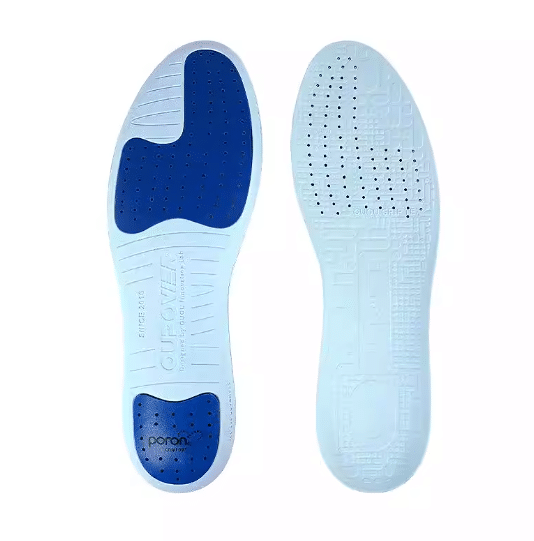
Football insoles are not thickened throughout, but instead embed high-elastic materials (such as PORON®) in the heel and metatarsal areas of the forefoot, like placing miniature shock-absorbing springs in key positions. They cushion upon landing and provide rebound when pushing off, balancing protection and explosive power.
3. Power transmission
Professional insoles usually adopt a multi-layered structure: the lower layer provides support and stability, the middle layer provides elastic transmission, and the upper layer provides anti-slip and a snug fit. It more efficiently transmits the force from the foot to the sole, reducing energy loss.
Thin ≠ Simple, Specialized ≠ Expensive
Many brands now offer replaceable performance insoles, allowing amateur players to experience the benefits of technology at a low cost. Next time you feel your football shoes are “lacking something,” maybe it’s not the shoes themselves, but the insoles that are quietly “underperforming.”
Switch to a good pair of insoles and let your performance on the field soar.